AI-Guided Regenerative Biomaterials

Engineering the regenerative niche for cell therapy

Regelife develops AI-guided biomaterials and hydrogel systems to enhance the survival, function, and delivery of therapeutic cells.

Hydrogel + neuron
Biomaterial scaffolds designed to support therapeutic cell performance in dynamic tissue environments.
Focus Microenvironment engineering
Platform AI/ML hydrogel design
Impact Better cell survival and delivery

Regelife sits at the intersection of biomaterials, machine learning, and regenerative medicine to build programmable environments for advanced cell therapies.

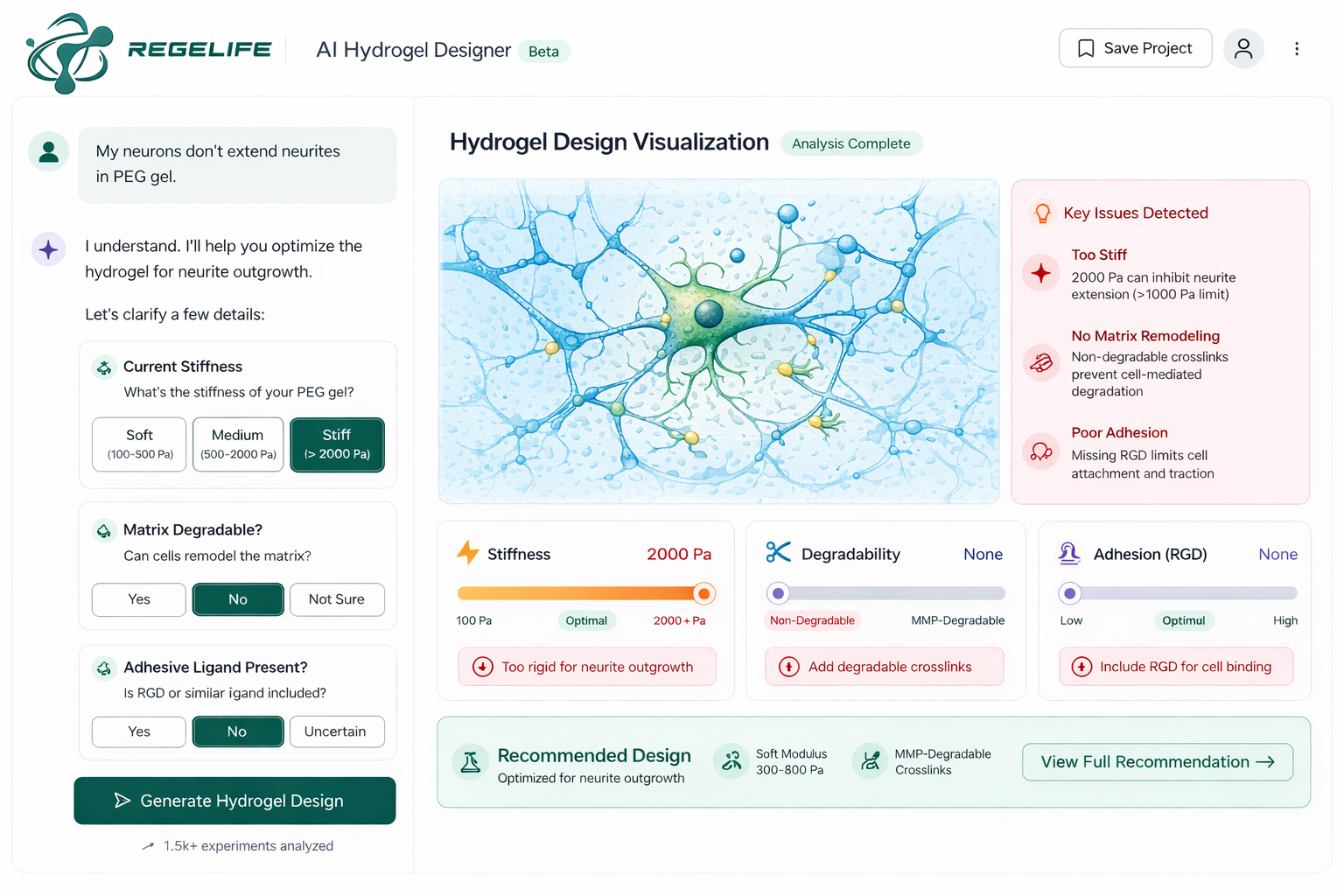
Product UI/UX
AI-powered hydrogel design product interface

The Problem

Cell therapies fail when the microenvironment is treated as an afterthought.

Therapeutic cells often lose viability, function, or delivery precision because the surrounding niche is poorly controlled across development, manufacturing, and administration.

Survival drops after delivery

Cells encounter hostile mechanical and biochemical conditions that reduce persistence at the target site.

Function becomes inconsistent

Without tunable support matrices, potency and phenotype drift across batches and treatment settings.

Manufacturing does not translate cleanly

Process conditions that work in vitro often fail to map to real therapeutic environments.

Our Solution

ML-guided hydrogel design for programmable regenerative niches.

Regelife integrates experimental biomaterials data with AI/ML models to design hydrogel systems tailored for cell viability, differentiation, retention, and delivery.

01

Map material-performance relationships

Link hydrogel composition, mechanics, and transport properties to cell outcomes.

02

Use AI/ML to predict optimal formulations

Rank candidate material systems for specific therapeutic and manufacturing objectives.

03

Deploy across development and delivery workflows

Create a consistent platform from cell processing through implantation or injection.

Applications

One platform, multiple cell engineering and translational use cases.

Cell Therapy

Improve delivery, retention, and therapeutic efficacy by engineering supportive hydrogel environments around living cells.

Disease Modeling

Recreate tissue-relevant microenvironments that generate better in vitro models for screening and mechanistic studies.

Cell Manufacturing

Design matrices and process conditions that stabilize quality and improve reproducibility during scale-up.